P.O. Box 80, Cooper Station
New York, NY 10276
212-673-7922
208-693-6152 fax
Untitled (A Skier) In Finland, in the `everpresent high latitude sunlight which causes nausea and an irresistible desire to read philosophy,' Franz, the narrator of this first novel, practices his skiing and contemplates his mother's life, a life demarcated by suicide. Written in one long stream-of-consciousness paragraph sprinkled with italicized words, Franz's musings travel in concentric circles, constantly revisiting metaphors and themes: three creatures falling long distances (a cat, a mouse, a dead pheasant); the movement of the glacier; the relationship of his married philosophy professor with Ingrid, a student fascinated by Wittgenstein (of the suicidal brothers); his father/coach's disappointment at his poor finish in a ski meet in Kitzbhel, Austria, during which his mother hangs herself....[Randie Lipkin portrays] Franz's family, particularly his mother, through the slow, spotty accretion of understanding, a kind of metaphysical pointillism. Lipkin's writing is sometimes humorous-especially about the carefree Matti or the Kitzbhel commentators gloating happily over Franz's human interest story-but the suggestive gaps (as Wittgenstein, the book's guiding spirit, is famous for saying, "Whereof one cannot speak, thereof one must be silent") are the most moving. A verbal flux lingers in some sort of permanence in this highly unusual first novel, for the spirit of Wittgensteinian philosophical disquisitions permeates it utterly. Tenebrous rooms, hesitating human interactions, feelings of futility and helplessness, the sensation of blackness that suggests the presence of non-existence, time itself, reverting to some softness of implosion, laid waste before the indeterminacy of ultimate meaning. And Wittgenstein's shade wanders through it, with continual reference to his isolated hut on the Finnish coast where, beside the stark stasis of the fields and sea, his mind in its ferment conceived of a kind of verbal entropy, a sort of end game of cognition, now brought into the realm of the novel, a novel unique in its juxtaposition of a Finnish downhill skier's angst at the beholding of the speed of his descent, his pursuit of athletic excellence, contemplation of his mother's suicide, while overriding it all is the drive of an unhinging search for a linguistic keystone, lost as it is somewhere in the unfocus of language. Where is the primal crux of meaning? Where is certainty in a forest of lying semiotics, linguistic quantifiers? Perhaps it resides in the descriptive simplicity of the prose, an unadorned staccato at times, continually looking back in its narration to that which has come before and will come again, all intended to prove that the real drama is the mystery of unknowing. 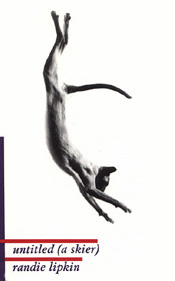
by Randie Lipkin
$8.00 188 pp. ISBN 1-879193-03-5
Although most first novels tend to be simple autobiographical books, this novel is an amazing, puzzling, and demanding text. I think that it is a "major" work.
--Irving Malin, Review of Contemporary Fiction
--Publishers Weekly
�Arnold Skemer, ZYX
