P.O. Box 80, Cooper Station
New York, NY 10276
212-673-7922
208-693-6152 fax
Without "Smokestacks, one with white stripe. This roof, series of flat roofs (the sky between). Window, edges of smoke. Smoke lifted past striped stack. Bird's shadow." This is the beginning of the second sequence of this extraordinary novel--one built like a film. I have been eagerly waiting for Lipkin's second novel. It confirms her rare talent. This novel, like her first one, Untitled (a Skier), is a daring, wise, beautiful exploration of the "cruelty of everyday living," of mysterious loss. It explores Wittgenstein's vision of language's limitations, mysterious "reality." Set in Tokyo, this slim, minimalist volume leans heavily on oblique dialogue, condensing enormous amounts of anguish into brief exchanges between various members of the Tanaka family....Lipkin simulates the fragmented experience of living alone, of being divorced, [and] of outliving a loved one. 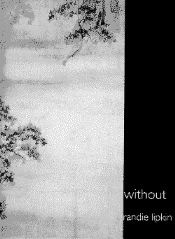
by Randie Lipkin
$7.00 152 pp. ISBN 1-879193-06-X
An Ozu film, we soon learn. "Setsuko's neck, the sleeve of her red-orange dress. Her hand as it pushes. Another desk, another desk, more necks, more pushing hands. All their backs, their pushing, nodding. Setsuko turns to window where smoke lifts."
Not only is the novel comprised of short, cinematic, seemingly simple scenes designed entirely to hold dialogue, there are also "quotes" from Ozu. There is the red teapot moving about, just as it does in the Ozu scene, there is an inn at Atami which has rooms at a "very good price" ("Tokyo Story"), youngsters who say "I love you" ("Good Morning"); the characters are named Shige and Shukichi, Noriko and Setsuko, all good Ozu names, and there is that everyday air which so casually evokes eternity.
At a bar, the Moonbeam, Shukichi is drinking sake and complains to the barman, "Itakura--it's cold." His friend Kogo remonstrates, "Don't punish Itakura because you waited too long, it's unfair." "I didn't wait," says Shukichi, to which Kogo replies: "Very unfair. Life's unfair--ask anyone here."
The rendering of this passage in the novel is even more laconic, just as concise as in an Ozu picture. There is no designation as to who is talking, only the skillful sequencing that makes sure the reader does not get lost, and there is the great confidence in this same reader's powers of deduction.
The language is pared down. If an article is not needed it is not there. There are no qualifiers in these sentences. What you see is what you get. "Boxes of food, cloth-wrapped packages between heavy and small green trees... On the ground, genetically-engineered pear, a hand, record player, Hank Williams record."
As Williams' presence attests we are no longer in the Fifties but we are still very much in the world of Ozu. We are also, consequently, in the realm of the experimental novel, that now nearly extinct form which has so vivified experience.
Just as Ozu might be seen (despite the tradition which also informs his work) as a prime Modernist, so this faithful novel which so clearly mirrors the seemingly conventional Ozu world is also a reflection of that Modernist ethic which, as one of its critics has said, means "the ruffling of the realistic surface of literature by underlying forces."
Modernism as a technique, says Frank Kermode, concerns a breaking away from established rules, traditions and conventions, fresh ways of looking at man's position and function in the universe and many experiments in form and style.
Among these are, of course, the novels of Joyce and Woolf, of Robert Musil and Alfred Döblin, of Yasunari Kawabata ("Asakusa Kurendaidan"), but nearer the Modernism of both Ozu and Lipkin, there are the remarkable conversational experiments of Ivy Compton-Burnett (whole novels of dialogue, the meaning of which lies between the lines) and Henry Green--in Loving the talk is all implication and the reader must practice an uncommon degree of inference. Other Green novels, such as Party Going and Doting are unforgettable in that one has invested so much attention and responsibility in just reading them.
Ozu shares this quality (though he certainly never read Green) because his detailed pace demands the closest attention, and because his lightest reflection cracks open to reveal "the underlying forces." Lipkin, (who may not herself have read either Green or Compton-Burnett) in her homage to Ozu and quotidian Japanese life willy-nilly avails herself of all the resources of Modernism to construct a mirror-image world where the real shines through the apparent.
This reality cannot be firmly grasped. It can only be apprehended as it departs. Thus the book is about loss, about nothingness. (Ozu has carved on his tombstone, the character mu, translated as "nothingness.") The clarity of Lipkin's Tanaka family is that they understand the sadness of this awareness of evanescence, this necessity of accepting the processes of time.
The book is thus an extraordinary act of homage, a treatise on less always meaning more, and at the same time a completely original look at time, space, and red teapots. This small and perfect world fits in the pocket (4 1/4 by 5 3/4 inches) and perhaps ought to be regarded as a sort of breviary.
--Donald Richie, The Japan Times
The novel is set in Japan. There are many characters who are haunted by the need to achieve stability (of love, faith, art) but who discover that instability, change, rule them. There are references to death, divorce, separation (of family, gender, rituals). The dialogue is elliptical, as if language itself is without certainty. Here, for example, are some typical sentences: "Marriage and children are no indication of anything"; "I never know when you mean what you're saying"; "I won't be able to hear what he's saying. I can't listen to someone I don't know."
There are descriptions of a Finnish film and a traditional Japanese drama. The film (its very nature consists of "moving" images) is described in a haunting, disturbing way. Lipkin uses odd syntax--there are missing verbs, few declarative sentences. It reads like an incomplete translation (one of the characters is a translator, always aware of deadlines). There are allusions to "backs," "unfolding fans," "shadows," "edges," "lines of descending fabric." Objects are not solid, complete, fixed.
The novel then suggests that change rules reality, that reality itself is an edge; although some of the characters can endure change, they need to do the same things again and again, as if to stabilize their identities. But these solitary rituals, vigils, cannot ward off panic. If we recognize the odd syntax--the symbols of fading flowers, flashing signs, ticking clocks--the present participle recurs: we are prepared for the wonderful complexity (perplexity?) of the last two sentence/paragraphs: "She pushes her cloth forward, half-standing, half-running." The final sentence: "As they reach end of corridor, he's ahead of her, passing her as he returns." The sentence conveys in its very movement, that "passing" "returns." Nothing stands still except the artistic "act of attention." Without is, then, a brave attempt to capture and shape change. It sanctifies absence.
--Irving Malin, Review of Contemporary Fiction
--Publishers Weekly
